
Your Cart

0

Suggested Item

Subtotal
$0.00

Please note: this webstore only allows checkout in the USA.
For a complete list of resellers, please visit our Where to Buy page.

By clicking Checkout you agree to our Terms of Service.
Charges will appear as RUPERT NEVE DESIGNS on your statements.

Image of 542 Tape Emulator

The classic sound of analog tape, plus Silk Red & Blue harmonic saturation.

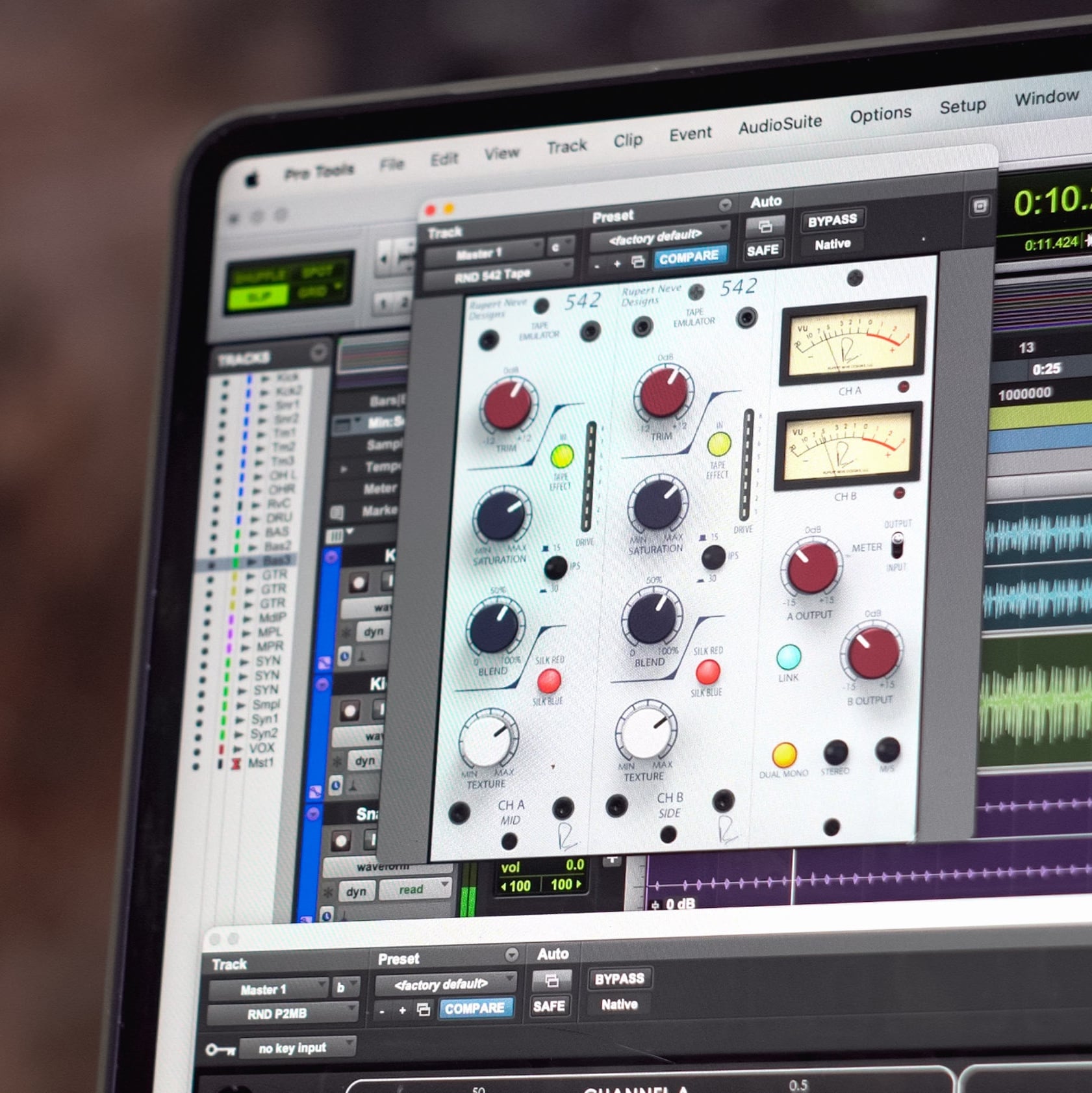
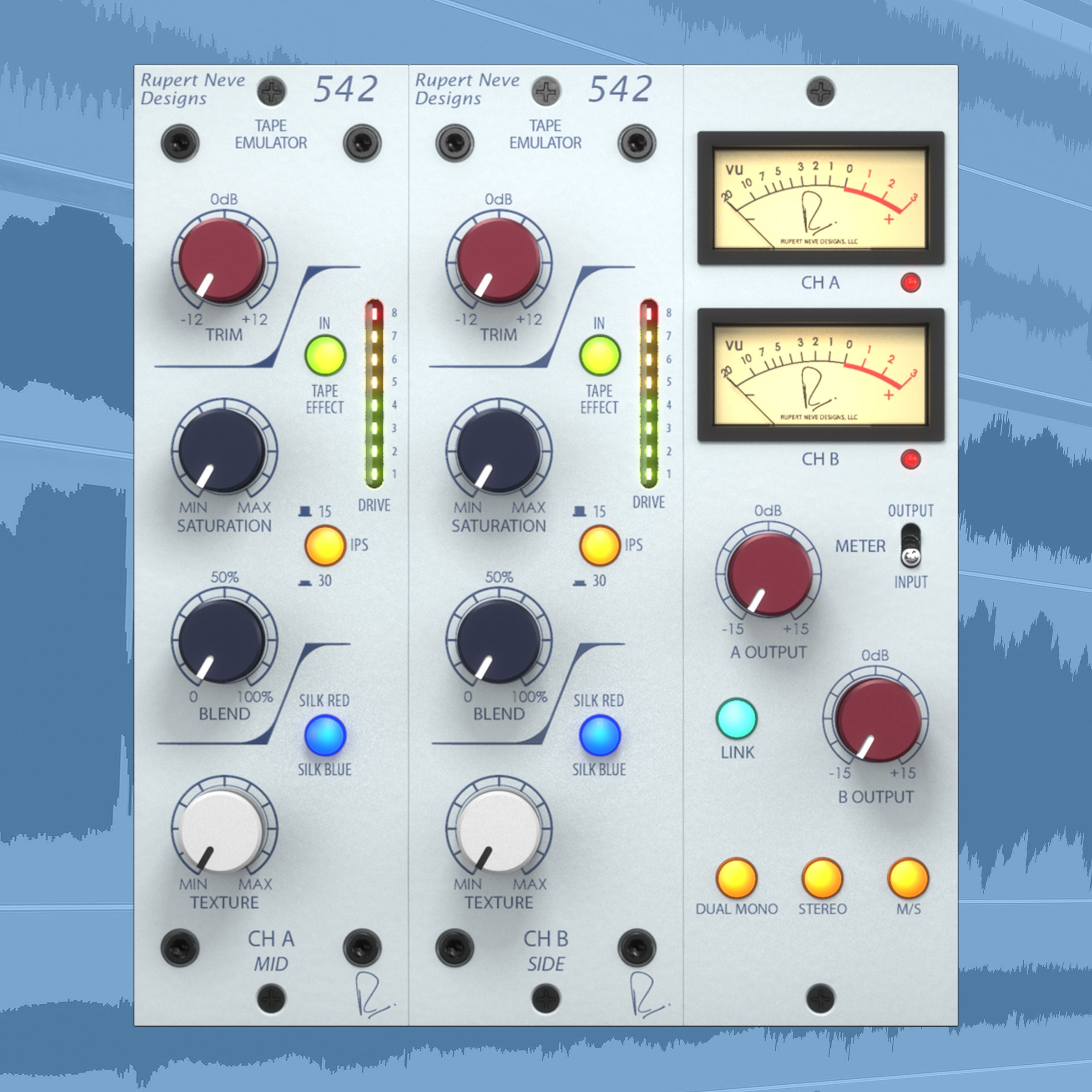
The 542 Tape Emulator Plug-in is a faithful recreation of the 542 500-series hardware Rupert Neve Designs originally released in 2013. The 542 delivers a wide variety of elusive analog tones by incorporating a carefully crafted tape emulation section, complete with a soft-clipper that can tame the harshest sources, our unique Silk section with variable Texture control, and a Blend control to finalize exacting amounts of saturation. The plug-in was meticulously modeled to emulate everything the hardware offers, with the addition of several new features, including true M/S processing and input/output metering.

  • Harmonic saturation increases as more gain is applied and a soft clip circuit engages at higher levels, gently taming peak transients
  • The sound can be further modified with selectable 15 / 30 IPS modes and a pre/post-tape emulation blend control
  • Silk Red mode accentuates transformer-modeled saturation in the high and high-mid frequencies to heighten the frequency range associated with Rupert’s vintage equipment
  • Silk Blue accentuates saturation of the lows and low-mids to add thickness and weight to any source
  • Crank the Texture knob for a rich, saturated, vintage vibe – or disengage Silk entirely for a more purist, hi-fi tape effect

Please note that an iLok account is required to use this plug-in. You can visit our Support page for more information.

$129.00

Located outside the USA? Please visit our Where to Buy page.

  • “I was an early, early adopter of the 542 hardware. The new plug-in is an incredible software recreation of this hardware, and I can’t tell the difference between the hardware and software. The 542 plug-in tames harsh transients like tape, it gives the sound a cohesive quality that I miss when it’s taken out…take my money!!"
    GREG WELLS (ADELE, KATY PERRY, TAYLOR SWIFT)
  • "Helps you make even the most digital of sounds feel loved."
    JOHN O'MAHONY (METRIC, SARA BAREILLES)
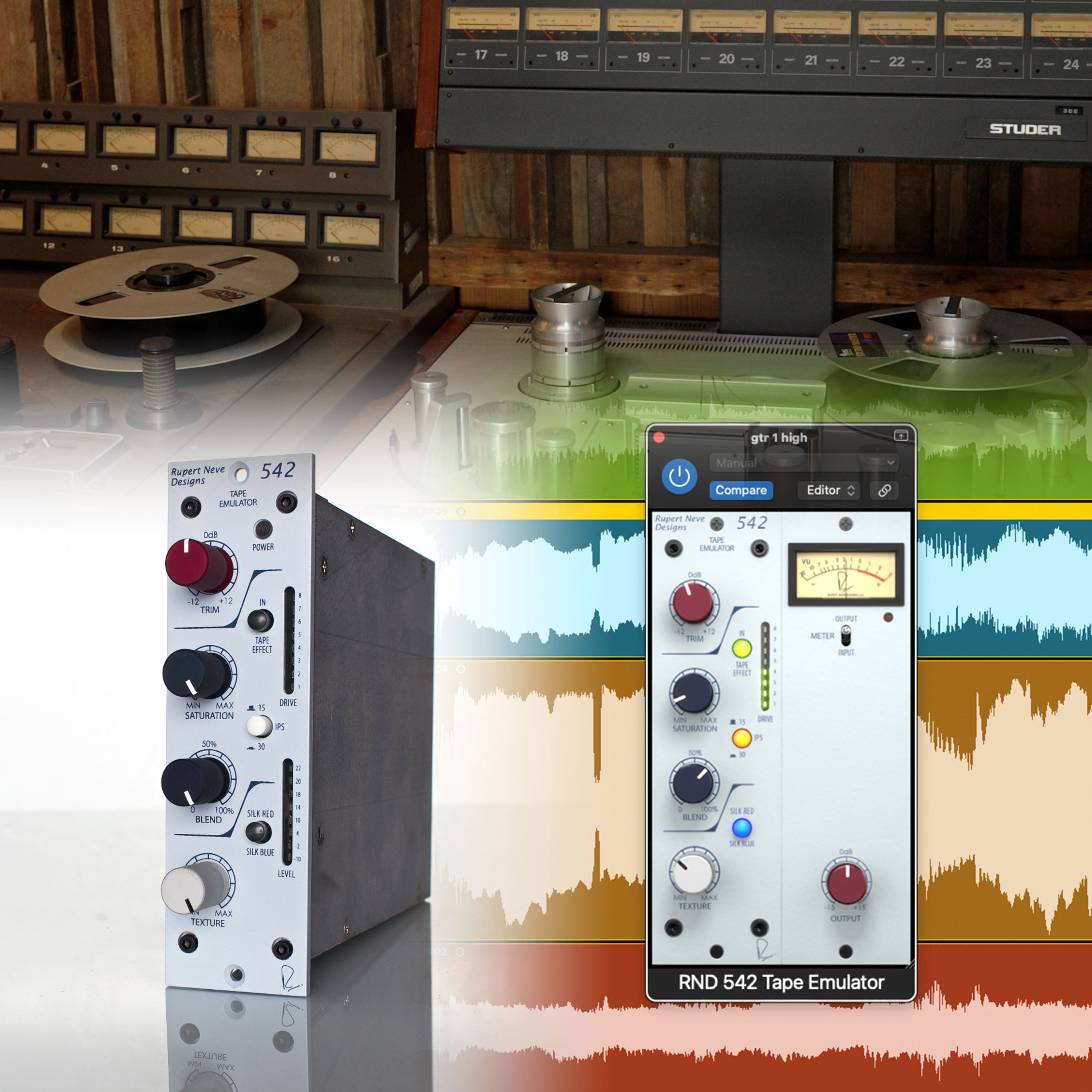
542 Tape Emulator software hardware and tape machines

Trusted Tape Tone for 20+ Years
When RND's original Portico 5042 Tape FX unit debuted in 2005, Sound On Sound noted that it had "virtually no direct competition". 20 years later the industry is full of countless tape emulators – but the hardware 542 remains the leader of the pack. Now its elusive analog tones are finally available in plug-in format, bringing the antidote to sterile recordings directly to your DAW.

542 screenshot

Lo-Fi to Hi-Fi and In Between

With separate control over input level, saturation, parallel blend, and 15 or 30 ips modes, the 542 plug-in can achieve any desired saturation level from overdriven lo-fi to a subtle purist hi-fi tape effect. Couple that with a soft-clip limiter than engages at higher Drive levels and our unique Silk Red + Blue transformer saturation, a huge variety of analog tones are at your fingertips.

542 screenshot

From Studio to Stage

Though analog tape machines are generally found in studios, the 542 hardware has been used for years as a secret weapon gluing together the sound for countless touring artists on stages worldwide. Since the 542 plug-in supports the AAX Native, AU, and/or VST3 plug-in formats, it's easier than ever to access that ’tape sound’ in the studio or on the road.

  • Does increasing the SATURATION amount also turn up the level?
    Not exactly. As the SATURATION knob is turned toward MAX, the frequency response changes & more harmonic distortion is added, but the overall output level remains consistent.
  • What is the difference between the 15 IPS and 30 IPS settings?
    These 2 settings are emulating two different ‘tape’ speed frequency responses. The 15 IPS mode has a significant “head bump” in the low frequencies centered around 60Hz and a more pronounced roll off in the high frequencies. The 30 IPS mode is generally a flatter response altogether with a “head bump” around 120Hz.
  • How does M/S Mode work on the 542 plug-in?
    In M/S mode, CH A becomes the mid channel and CH B becomes the side channel. This allows you to process each channel independently, which can be helpful when dialing in M/S processing on a stereo bus or the master bus. Please also note that the CH A & CH B input & output trims give you flexible control over the mid/side level ratio. If you want to experiment, we recommend trying 15 IPS on CH A and 30 IPS on CH B as a starting point!
  • Does the BLEND knob blend the TAPE EFFECT and SILK processed signal with the dry signal?
    No, the BLEND knob only blends the signal processed by the TAPE EFFECT with the dry signal. The SILK section is Post TAPE EFFECT and BLEND, so SILK is not affected by the BLEND setting.
  • What’s the difference between BLUE and RED SILK?
    Red SILK focuses the harmonics in the upper mids and highs while Blue SILK focuses the harmonics in the low mids and lows. The TEXTURE control allows you to fine-tune the ideal amount of harmonics added to the signal, whether or not the TAPE EFFECT is engaged.
  • Is there a soft-clipper built into the 542 plug-in?
    Yes, you can achieve soft-clipping by driving the INPUT TRIM and/or SATURATION levels until the DRIVE meter starts to hit ‘5’ (yellow).
  • How does the LINK button work on the 542 plug-in?
    On the 2-CH instance of the 542 plug-in, engaging the LINK button ‘links’ all the 542 controls to each other. This can be used in DUAL MONO, STEREO or M/S processing modes. Please make sure to engage link first if you want the controls to stay matched as you adjust one channel.